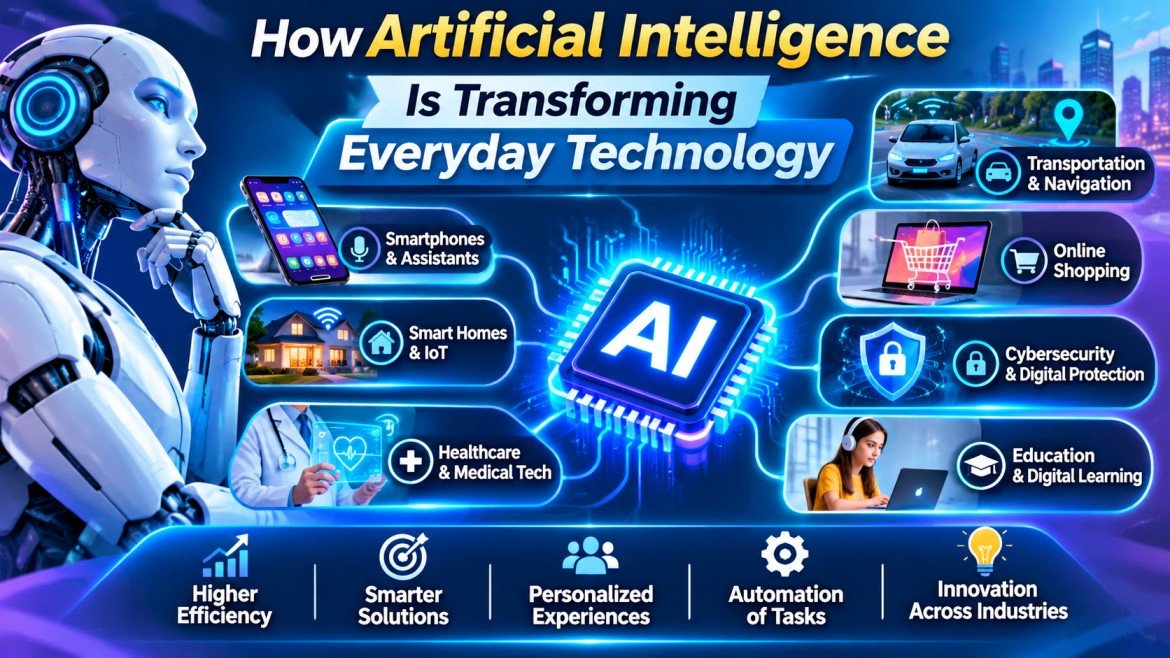
Technology is becoming smarter every day. From smartphones that recognize faces to navigation apps that suggest faster routes, artificial intelligence is quietly changing how people interact with digital devices.
What once seemed like science fiction is now part of everyday life. AI-powered systems can understand language, recognize images, analyze information, recommend content, and automate tasks that previously required human effort.
But artificial intelligence is not limited to chatbots or virtual assistants. It is also transforming healthcare, transportation, smart homes, online shopping, cybersecurity, and business operations.
In this guide, we explore how Artificial Intelligence works, where it is being used, its benefits and limitations, and how it may shape the future of everyday technology.
What Is Artificial Intelligence?
Artificial Intelligence, commonly known as AI, is a field of computer science focused on creating systems that can perform tasks associated with human intelligence.
These tasks may include learning from data, recognizing patterns, understanding language, solving problems, and making predictions.
Traditional software generally follows instructions written by developers. AI systems can use models trained on data to identify patterns and produce results based on what they have learned.
For example, an email service can use AI to identify suspicious messages, while a smartphone camera can automatically recognize a face and adjust its image settings.
AI technologies include several important areas:
- Machine Learning: Systems learn patterns from data and use them to make predictions.
- Deep Learning: A type of machine learning that uses multi-layered neural networks.
- Natural Language Processing: Technology that helps computers understand and generate human language.
- Computer Vision: Systems that analyze images and videos.
- Generative AI: Technology that can generate text, images, audio, video, and other content.
These technologies are helping make modern devices and digital services more intelligent.
How Artificial Intelligence Works
Artificial intelligence systems use data, algorithms, and trained models to perform specific tasks.
Although different AI applications work differently, the general process often involves these stages:
1. Data Collection
An AI system receives information such as text, images, audio, video, or numerical data.
2. Data Processing
The collected information is organized and prepared so the system can analyze it.
3. Model Training
Machine learning models identify patterns in training data. During this process, the model adjusts its internal parameters to improve its performance.
4. Prediction or Generation
After training, the model can analyze new information and produce an output, such as a recommendation, classification, prediction, or generated response.
5. Evaluation and Improvement
Developers evaluate the system to identify errors, measure performance, and improve its reliability.
It is important to understand that AI does not automatically think or understand everything like a human. Its results depend on the data, model design, instructions, and limitations of the technology.
7 Ways Artificial Intelligence Is Transforming Everyday Technology
Artificial intelligence is becoming part of many products and services people use regularly.
1. Smartphones and Personal Assistants
Modern smartphones use AI for features that make everyday tasks easier.
For example, AI can help improve photographs, recognize faces, organize images, predict text, and support voice commands.
Virtual assistants can also respond to questions, create reminders, and help users manage daily activities.
Examples of AI-powered smartphone features:
- Voice recognition
- Smart photo editing
- Face recognition
- Predictive text
- Live translation
- Intelligent battery management
These features help devices respond more effectively to user needs.
2. Smart Homes and Connected Devices
Artificial intelligence is making smart homes more responsive and convenient.
Smart thermostats can learn temperature preferences, security cameras can identify certain types of activity, and voice-controlled assistants can manage compatible connected devices.
AI can also work alongside Internet of Things technology to analyze information collected by connected sensors.
For example, a smart home system may use sensor information to adjust lighting or temperature based on programmed preferences.
Common applications include:
- Smart lighting
- Intelligent thermostats
- Connected security cameras
- Smart door locks
- Voice-controlled appliances
- Home energy monitoring
AI and IoT are closely related, but they are not the same technology. IoT connects devices and collects data, while AI can analyze that data and support automated decisions.
3. Healthcare and Medical Technology
Healthcare is another important area where AI is being explored and adopted.
AI systems can help analyze medical images, organize healthcare information, support administrative work, and assist researchers in studying complex medical data.
For example, some AI-powered imaging systems can help medical professionals identify patterns in X-rays, CT scans, and other medical images.
Important applications include:
- Medical image analysis
- Healthcare data management
- Patient scheduling
- Research and drug discovery
- Clinical decision-support systems
- Remote patient monitoring
AI is intended to support qualified healthcare professionals, not replace medical judgment. Its outputs need appropriate human review.
4. Transportation and Navigation
Navigation applications use intelligent systems to analyze traffic information, estimate travel times, and suggest alternative routes.
AI can also support advanced driver-assistance systems by helping vehicles recognize road markings, nearby objects, and potential hazards.
Examples include:
- Traffic prediction
- Route recommendations
- Driver-assistance technology
- Vehicle monitoring
- Fleet management
- Predictive maintenance
Autonomous driving remains a complex field, and capabilities vary significantly between vehicles and operating environments.
5. Online Shopping and Digital Marketing
AI is changing how customers discover products and interact with online stores.
Shopping platforms can analyze browsing patterns, purchase history, and product information to generate personalized recommendations.
Businesses also use AI to organize customer support, analyze marketing performance, and understand shopping trends.
Common uses include:
- Product recommendations
- Personalized search results
- Customer support chatbots
- Fraud detection
- Demand forecasting
- Marketing analysis
These systems can make online shopping more convenient, although users should understand that recommendations may be influenced by commercial and advertising interests.
6. Cybersecurity and Digital Protection
Cybersecurity systems use AI and machine learning to analyze activity and identify potentially suspicious behavior.
Traditional security tools often rely on known threat signatures. AI-powered systems can also examine patterns that may indicate unusual or malicious activity.
AI applications in cybersecurity include:
- Suspicious login detection
- Phishing identification
- Network activity monitoring
- Malware behavior analysis
- Fraud detection
- Security alert prioritization
AI can help security teams process large amounts of information, but it does not guarantee that every attack will be detected.
Human monitoring, software updates, strong passwords, and reliable backups remain essential.
7. Education and Digital Learning
AI is also creating new possibilities for students, teachers, and educational platforms.
AI-powered learning applications can explain concepts, generate practice questions, provide language support, and help students review difficult subjects.
Teachers may use AI tools to prepare educational materials, organize lessons, and support administrative tasks.
Examples include:
- Personalized learning recommendations
- AI tutoring assistants
- Language translation
- Writing assistance
- Automated practice exercises
- Learning progress analysis
AI-generated educational content should be checked for accuracy, especially when it includes technical or factual information.
Artificial Intelligence vs Traditional Technology
AI and traditional software can both solve problems, but they approach tasks differently.
| Feature | Traditional Software | AI-Based Systems |
|---|---|---|
| Operation | Follows programmed rules | Uses trained models and instructions |
| Data analysis | Depends on programmed logic | Can identify complex patterns |
| Adaptability | Changes require code updates | Can be improved through training or updates |
| Predictions | Uses predefined calculations | Can generate predictions from learned patterns |
| Content generation | Usually template-based | Can generate new content |
| Examples | Basic calculators and fixed-rule systems | Image recognition and language models |
Neither approach is automatically better. Many modern applications combine traditional programming with AI models to provide reliable functionality.
Benefits of Artificial Intelligence
Artificial intelligence offers several advantages across personal, business, and industrial applications.
Improved Efficiency
AI can automate repetitive activities and help people complete certain tasks more quickly.
Better Data Analysis
Machine learning systems can analyze large datasets and identify patterns that may be difficult to find manually.
Personalized Experiences
AI can help applications adapt recommendations, search results, and interfaces to individual preferences.
Enhanced Accessibility
Speech recognition, translation, text-to-speech, and image descriptions can make technology more accessible to different users.
Faster Decision Support
AI can organize information and generate insights that help professionals evaluate different options.
Innovation Across Industries
AI is supporting new applications in healthcare, manufacturing, transportation, education, and digital services.
Challenges and Limitations of Artificial Intelligence
Despite its benefits, AI also introduces important challenges.
1. Data Privacy
AI systems may process personal or sensitive information. Organizations must handle that information responsibly and follow applicable privacy laws.
2. Incorrect Information
Generative AI can produce inaccurate or misleading answers. Users should verify important information instead of accepting every result.
3. Bias in AI Systems
If training data contains bias, an AI model may produce unfair or inaccurate outcomes.
4. Security Risks
AI technologies can be misused to create convincing scams, phishing messages, fake media, and other harmful content.
5. Cost and Infrastructure
Developing and operating advanced AI systems can require significant computing resources, specialized skills, and investment.
6. Human Oversight
Important decisions involving health, finance, employment, and safety require appropriate human supervision.
Responsible AI development requires transparency, testing, security, and accountability.
The Future of Artificial Intelligence
Artificial intelligence is expected to remain an important part of technological development.
Several areas are attracting attention:
AI Agents: Systems that can perform multiple connected tasks with varying levels of human supervision.
Edge AI: AI processing performed directly on devices instead of relying entirely on remote cloud servers.
Multimodal AI: Models that can work with different types of information, including text, images, audio, and video.
Robotics: AI systems that help robots understand their surroundings and perform more complex tasks.
AI in Healthcare: Continued development of tools for medical research, image analysis, and healthcare administration.
Smart Manufacturing: AI-powered systems that support quality inspection, predictive maintenance, and production planning.
The long-term impact will depend on how these technologies are developed, regulated, and adopted.
Frequently Asked Questions
1. What is artificial intelligence in simple words?
Artificial intelligence is technology that enables computers to perform tasks such as recognizing images, understanding language, analyzing information, and generating content.
2. How is AI used in everyday life?
AI is used in smartphones, navigation applications, online shopping, smart home devices, email filtering, digital assistants, and many other services.
3. What is the difference between AI and machine learning?
Artificial intelligence is the broader field of creating intelligent computer systems. Machine learning is a part of AI that enables systems to learn patterns from data.
4. Is artificial intelligence the same as automation?
No. Automation follows programmed processes to complete tasks, while AI can analyze information, recognize patterns, and generate predictions or responses. Some modern systems combine both technologies.
5. Can artificial intelligence replace human workers?
AI can automate certain tasks and change the way some jobs are performed. However, its impact varies by industry, and many roles continue to require human judgment, creativity, communication, and responsibility.
6. Is artificial intelligence safe to use?
AI can be useful when used responsibly. Users should protect personal information, verify important outputs, and avoid relying on AI alone for high-impact decisions.
7. What are the main types of artificial intelligence?
Common AI categories include machine learning, deep learning, natural language processing, computer vision, and generative AI.
Final Thoughts
Artificial intelligence is changing how people use technology, communicate, work, shop, learn, and manage everyday activities.
From smartphones and smart homes to healthcare systems and cybersecurity platforms, AI is helping digital products become more capable and responsive.
However, its benefits come with responsibilities. Privacy, security, accuracy, and human oversight must remain important as AI becomes more widely integrated into everyday technology.
Understanding how artificial intelligence works today can help individuals and businesses make better decisions about the digital tools they use tomorrow.
for more updates: click here