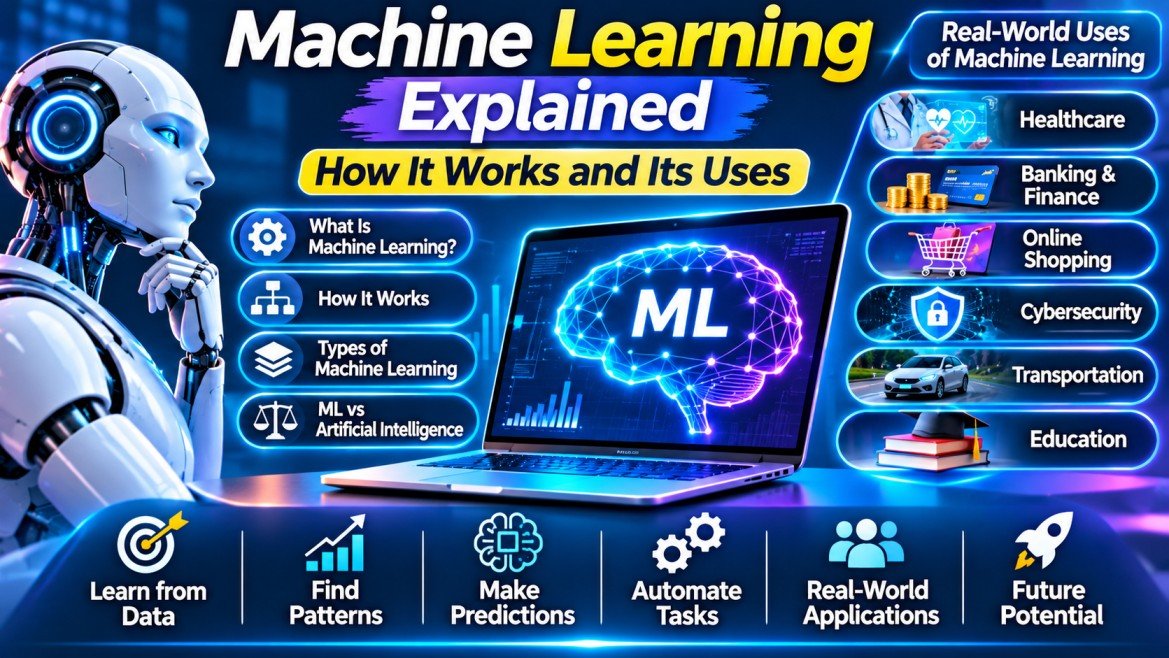
Technology is becoming smarter, faster, and more capable of handling complex tasks. From Netflix recommendations and online shopping suggestions to fraud detection and voice assistants, many modern digital services rely on a technology called machine learning.
You may have already used machine learning without realizing it. When your email automatically identifies spam, your navigation app predicts traffic, or an online store recommends products based on your interests, machine learning may be working behind the scenes.
But what exactly is machine learning, and how does it work?
Machine learning is one of the most important areas of modern technology. It helps computers identify patterns, learn from data, and make predictions without requiring developers to manually program every possible situation.
In this guide, we explain, its working process, major types, real-world applications, benefits, limitations, and future potential.
What Is Machine Learning?
it is a branch of artificial intelligence that enables computer systems to learn patterns from data and improve their performance on specific tasks.
In traditional programming, developers provide instructions that tell a computer exactly what to do. In machine learning, developers provide data and a learning algorithm that can identify patterns and build a model.
For example, imagine creating an application that identifies spam emails.
Instead of writing separate rules for every possible spam message, developers can train a machine learning model using examples of spam and legitimate emails. The model learns patterns that help it classify new messages.
it is used in many industries, including:
- Healthcare and medical research
- Banking and financial services
- Online shopping
- Cybersecurity
- Transportation
- Manufacturing
- Entertainment
- Education
it does not mean that computers think exactly like humans. It means that algorithms can learn statistical patterns from data and use them to produce useful results.
How Does Machine Learning Work?
it systems generally follow a process that involves collecting data, preparing it, training a model, testing its performance, and using it to make predictions.
Let’s understand each stage.
1. Data Collection
The first step is collecting relevant data.
Depending on the application, data may include images, text, numbers, audio recordings, customer information, or sensor readings.
For example, a machine learning system designed to identify fraudulent transactions may use historical payment information and examples of suspicious activity.
The quality of this information is important because poor-quality data can lead to inaccurate results.
2. Data Preparation
Raw data often contains missing values, duplicate records, errors, or irrelevant information.
Before training a model, developers prepare and organize the dataset.
This process may include:
- Removing duplicate records
- Correcting inaccurate information
- Handling missing values
- Organizing categories
- Selecting relevant features
- Converting data into suitable formats
Good data preparation helps improve the reliability of machine learning models.
3. Model Training
During training, a machine learning algorithm analyzes the prepared data and identifies patterns.
For example, a model trained to recognize cats may analyze thousands of labeled images and learn visual features such as ears, eyes, body shapes, and facial patterns.
The model adjusts its internal parameters to reduce prediction errors.
4. Model Testing
After training, developers evaluate the model using data it has not previously seen.
This helps determine whether the model has learned useful patterns or simply memorized the training examples.
Common evaluation measurements include accuracy, precision, recall, and F1 score. The appropriate measurement depends on the task.
5. Prediction and Deployment
Once the model performs sufficiently well, it can be integrated into an application or software system.
For example, a shopping website may use a machine learning model to recommend products based on customer activity.
The model can also be monitored and updated as new data becomes available.
Types of Machine Learning
Machine learning includes several major approaches. Each is designed for different types of problems and data.
1. Supervised Learning
Supervised learning uses labeled training data. This means that the examples provided to the model already include the correct answers.
The model learns the relationship between input information and expected outputs.
Examples:
- Email spam detection
- House price prediction
- Credit risk assessment
- Image classification
- Medical image analysis
For example, a system trained with labeled images of dogs and cats can learn to classify new images.
Supervised learning is commonly used when historical examples with known outcomes are available.
2. Unsupervised Learning
Unsupervised learning works with data that does not have predefined labels.
The algorithm attempts to discover patterns, structures, or groups within the information.
Examples:
- Customer segmentation
- Grouping similar documents
- Identifying unusual data patterns
- Organizing large datasets
- Discovering purchasing behavior
For example, an online retailer may use unsupervised learning to group customers with similar shopping habits.
This can help businesses understand customer behavior without manually defining every customer category.
3. Reinforcement Learning
Reinforcement learning is based on an agent learning through interaction with an environment.
The agent takes actions and receives rewards or penalties based on the results.
Over time, it learns which actions are more likely to produce favorable outcomes.
Examples:
- Robotics
- Game-playing systems
- Resource optimization
- Traffic signal control research
- Certain autonomous system applications
For example, a simulated robot can learn to navigate an environment by receiving rewards for reaching a destination and penalties for making unsuccessful movements.
4. Semi-Supervised Learning
Semi-supervised learning combines a smaller amount of labeled data with a larger amount of unlabeled data.
This approach can be useful when labeling large datasets is expensive or time-consuming.
For example, a company may have thousands of images but only a small number that have been manually categorized.
The model uses both types of information to learn useful patterns.
Machine Learning vs Artificial Intelligence
Machine learning and artificial intelligence are closely related, but they do not mean exactly the same thing.
Artificial intelligence is the broader field of creating computer systems capable of performing tasks associated with human intelligence.
Machine learning is one approach within AI that allows systems to learn patterns from data.
| Feature | Artificial Intelligence | Machine Learning |
|---|---|---|
| Meaning | Broad field of intelligent systems | Branch of AI |
| Main purpose | Perform intelligent tasks | Learn patterns from data |
| Techniques | Rules, search, machine learning, and more | Algorithms trained using data |
| Applications | Robotics, assistants, planning | Recommendations, prediction, classification |
| Relationship | Includes machine learning | Part of artificial intelligence |
For example, a voice assistant may use several AI technologies, including speech recognition, natural language processing, and machine learning.
8 Real-World Applications of Machine Learning
Machine learning is already being used in many everyday products and professional systems.
1. Healthcare
Healthcare organizations use machine learning to analyze medical information and support research.
Applications include:
- Medical image analysis
- Patient risk prediction
- Disease research
- Drug discovery
- Healthcare data analysis
- Hospital resource planning
this can help medical professionals identify patterns in large datasets. However, its results require appropriate clinical review and should not replace professional medical judgment.
2. Banking and Financial Services
Banks and financial institutions use machine learning to analyze transactions and identify unusual activity.
Applications include:
- Fraud detection
- Credit risk analysis
- Transaction monitoring
- Customer service automation
- Financial forecasting
- Suspicious account activity detection
For example, a banking system may flag a transaction that differs significantly from a customer’s usual spending pattern.
3. Online Shopping
E-commerce platforms use it to improve product discovery and customer experiences.
Applications include:
- Product recommendations
- Personalized search
- Customer segmentation
- Demand forecasting
- Inventory planning
- Shopping behavior analysis
When an online store recommends products related to your previous purchases, it may be involved.
4. Cybersecurity
Cybersecurity systems use machine learning to identify unusual patterns that may indicate malicious activity.
Applications include:
- Suspicious login detection
- Malware behavior analysis
- Spam filtering
- Network monitoring
- Fraud identification
- Phishing detection
it can help security teams process large amounts of information, but it cannot guarantee that every cyberattack will be detected.
5. Transportation
Transportation companies use machine learning to analyze traffic, vehicle performance, and route information.
Applications include:
- Traffic prediction
- Route optimization
- Predictive vehicle maintenance
- Fleet management
- Driver-assistance systems
- Transportation planning
Navigation applications can use historical and current traffic information to estimate journey times and suggest alternative routes.
6. Entertainment and Streaming
Streaming platforms use recommendation systems to help users discover content.
it can analyze viewing patterns, ratings, and user preferences to recommend movies, music, and television programs.
Applications include:
- Movie recommendations
- Music suggestions
- Personalized content feeds
- Audience analysis
- Content discovery
These recommendations can make digital entertainment more personalized.
7. Manufacturing
Manufacturing companies use machine learning to improve production and equipment management.
Applications include:
- Predictive maintenance
- Quality inspection
- Production forecasting
- Equipment monitoring
- Supply chain planning
- Defect detection
For example, a machine learning system may analyze sensor readings to identify patterns that suggest industrial equipment needs maintenance.
8. Education
Educational platforms can use machine learning to support personalized learning experiences.
Applications include:
- Learning recommendations
- Student performance analysis
- Automated assessment support
- Language learning
- Educational content recommendations
- Learning progress monitoring
These tools can help educators identify areas where students may need additional support.
Popular Machine Learning Algorithms
it uses different algorithms depending on the problem, available data, and desired outcome.
Here are some commonly used algorithms.
| Algorithm | Common Use |
|---|---|
| Linear Regression | Predicting numerical values |
| Logistic Regression | Classification problems |
| Decision Trees | Rule-based predictions |
| Random Forest | Classification and prediction |
| Support Vector Machines | Classification |
| K-Means Clustering | Grouping similar data |
| Neural Networks | Complex pattern recognition |
| Gradient Boosting | Predictive modeling |
Not every algorithm is suitable for every problem. Developers choose models based on performance, data size, interpretability, computational requirements, and other factors.
Benefits of Machine Learning
it offers several advantages when it is designed and applied correctly.
Better Data Analysis
it can analyze large datasets and identify patterns that may be difficult to discover manually.
Task Automation
It can automate certain repetitive activities, reducing the need for manual processing.
Improved Predictions
it models can use historical information to estimate future outcomes.
Personalized Experiences
Applications can provide recommendations based on individual preferences and behavior.
Faster Fraud Detection
Financial institutions can use to identify suspicious transaction patterns.
Continuous Improvement
Some machine learning systems can be retrained or updated as new data becomes available.
Challenges and Limitations of Machine Learning
Although offers many benefits, it also has limitations.
1. Data Quality
A model trained using incomplete, inaccurate, or biased data may produce unreliable results.
2. Privacy Concerns
Some applications require sensitive personal or business information. Organizations must protect this data and follow applicable privacy requirements.
3. High Computing Requirements
Training advanced models can require powerful hardware, specialized infrastructure, and significant computing resources.
4. Model Bias
If training data contains unfair patterns, the model may reproduce or amplify those patterns.
5. Lack of Explainability
Some complex models are difficult to interpret. Understanding why a model produced a particular result can be challenging.
6. Maintenance and Monitoring
Machine learning models may become less accurate when real-world conditions change. Developers need to monitor performance and update models when necessary.
Machine Learning vs Deep Learning
Deep learning is a specialized area of machine learning that uses neural networks with multiple layers.
It is particularly useful for complex tasks involving images, audio, language, and other high-dimensional information.
| Feature | Machine Learning | Deep Learning |
|---|---|---|
| Relationship | Broad field | Part of machine learning |
| Data requirements | Can work with smaller datasets | Often benefits from large datasets |
| Feature extraction | May require manual feature engineering | Can learn features automatically |
| Computing needs | Often lower | Often higher |
| Common applications | Fraud detection, forecasting | Image recognition, speech, language models |
Deep learning is not always the better choice. Traditional machine learning algorithms may be more efficient and easier to interpret for many business problems.
What Is the Future of Machine Learning?
Machine learning continues to evolve as computing technology, data availability, and AI research improve.
Several areas are attracting attention.
1. Generative AI: Machine learning models can generate text, images, audio, video, and other content.
2. Edge Machine Learning: Models can run directly on smartphones, cameras, vehicles, and other connected devices.
3. Explainable AI: Researchers are developing methods to make model decisions easier to understand.
4. Healthcare Innovation: Machine learning may continue supporting medical research, imaging analysis, and healthcare operations.
5. Robotics: it can help robots recognize their surroundings and perform more complex tasks.
6. Business Automation: Organizations can use predictive models to improve planning, customer support, and operational efficiency.
The future of will depend on responsible development, reliable data, privacy protection, and effective human oversight.
Frequently Asked Questions
1. What is machine learning in simple words?
Machine learning is a technology that allows computers to learn patterns from data and use those patterns to make predictions, classifications, or recommendations.
2. Is machine learning a part of artificial intelligence?
Yes. Machine learning is a branch of artificial intelligence. It focuses on developing systems that learn from data rather than relying entirely on manually written rules.
3. What are the four main types of machine learning?
The four commonly discussed approaches are supervised learning, unsupervised learning, reinforcement learning, and semi-supervised learning.
4. Where is machine learning used in everyday life?
It is used in email spam filters, online shopping recommendations, navigation apps, banking fraud detection, streaming services, voice assistants, and cybersecurity systems.
5. Is machine learning difficult to learn?
The basic concepts can be learned without advanced mathematics. However, building professional learning models requires knowledge of programming, statistics, data processing, and algorithms.
6. Which programming language is used for machine learning?
Python is widely used because it offers libraries such as Scikit-learn, TensorFlow, and PyTorch. Other languages, including R, Java, and C++, are also used in projects.
7. What is the difference between machine learning and deep learning?
Deep learning is a specialized type of that uses multi-layer neural networks to learn complex patterns from data.
8. Can machine learning work without the internet?
Yes. Some models can run locally on computers, smartphones, and other devices without a continuous internet connection. However, certain applications require cloud-based processing or online data.
Final Thoughts
Machine learning is an important technology behind many modern digital services. It helps computers analyze information, recognize patterns, make predictions, and provide personalized experiences.
From healthcare and banking to online shopping, transportation, and cybersecurity, its applications continue to expand across different industries.
Understanding how machine learning works makes it easier to understand the technology behind today’s intelligent applications and the innovations that may shape tomorrow’s digital world.
As it continues to develop, data quality, privacy, security, and responsible use will remain essential for building reliable systems.
For more updates:: click here