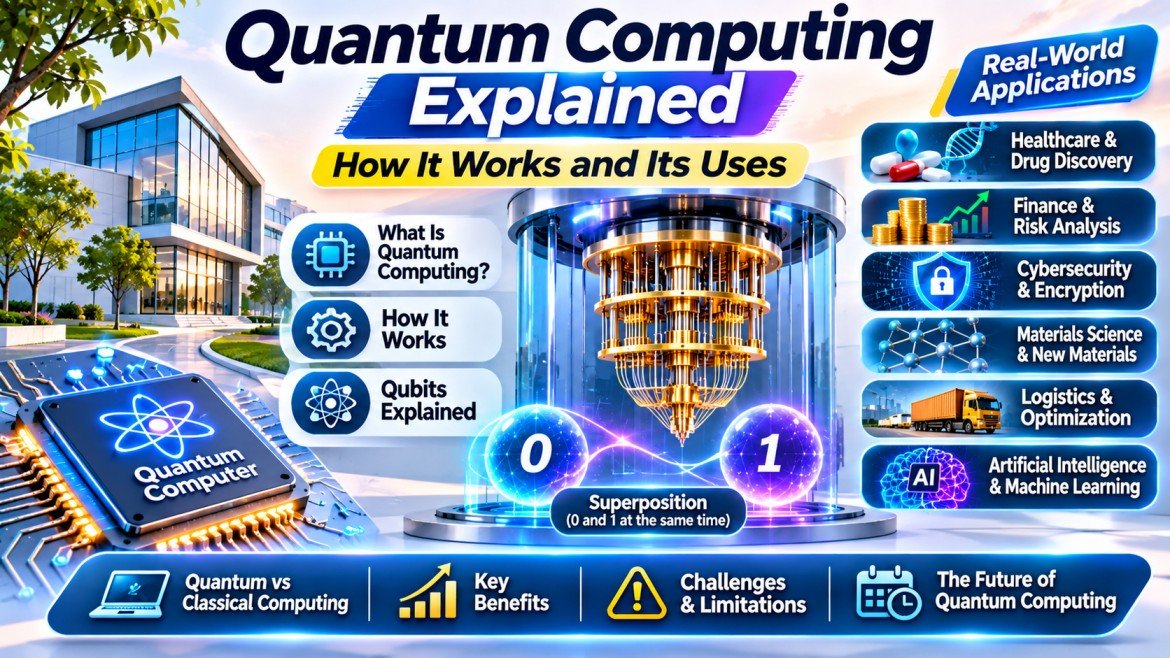
Imagine a computer that could help researchers study complex molecules, explore new materials, and solve certain scientific problems that are extremely difficult for traditional computers.
This is one of the possibilities behind quantum computing.
Unlike ordinary computers that process information using conventional bits, quantum computers use quantum bits, commonly called qubits. These special units of information follow the principles of quantum mechanics and allow computers to approach certain problems in fundamentally different ways.
Quantum computing is still an emerging technology, and practical applications are developing gradually. However, researchers and technology companies are exploring its potential in healthcare, finance, cybersecurity, chemistry, and scientific research.
In this guide, we explain Quantum Computing, how it works, what qubits are, how quantum computers differ from traditional computers, and where this technology may be useful in the future.
What Is Quantum Computing?
Quantum computing is a type of computing that uses principles of quantum mechanics to process information.
Traditional computers use bits that represent information as either 0 or 1. Quantum computers use qubits, which can be prepared in quantum states that involve combinations of 0 and 1.
This capability, together with quantum interference and entanglement, allows quantum algorithms to process certain problems differently from classical algorithms.
Quantum computing does not simply make every computer task faster. Its potential advantage applies to particular problems where quantum algorithms can offer a meaningful improvement.
For example, quantum computers are being researched for:
- Molecular and chemical simulations
- Materials science
- Optimization problems
- Certain mathematical problems
- Quantum physics research
- Cryptography research
Quantum computers are not designed to replace everyday laptops or smartphones. Instead, they may become specialized computing systems used alongside traditional computers.
How Does Quantum Computing Work?
Quantum computers operate using the principles of quantum mechanics. Their processing systems are designed to prepare, manipulate, and measure quantum states.
To understand the basic process, it helps to look at three important concepts: qubits, superposition, and entanglement.
1. Qubits: The Basic Units of Quantum Information
A classical computer uses bits to represent information. A bit has one of two possible values: 0 or 1.
A quantum computer uses qubits. A qubit can exist in a quantum state involving a combination of the basis states 0 and 1.
When a qubit is measured, the result is a classical outcome, such as 0 or 1, with probabilities determined by its quantum state.
Qubits can be physically implemented in different ways, including:
- Superconducting electrical circuits
- Trapped ions
- Photons
- Neutral atoms
- Other experimental quantum systems
Each approach has its own engineering challenges and potential advantages.
2. Superposition: Understanding Quantum States
Superposition is one of the central concepts of quantum computing.
A qubit can be prepared in a state that combines the possibilities of 0 and 1. This is different from a classical bit, which always stores one definite value at a time.
However, superposition does not mean that a quantum computer simply calculates every possible answer simultaneously and automatically gives the correct result.
Quantum algorithms use carefully designed operations to create interference between different possibilities. This can increase the probability of useful outcomes when the system is measured.
3. Entanglement: Connecting Qubits
Quantum entanglement is a phenomenon in which two or more quantum systems share a joint state that cannot be described as independent states of each system.
In quantum computing, entanglement allows qubits to represent complex relationships that are important for certain quantum algorithms.
It is one of the resources that makes quantum computing different from traditional computing.
4. Quantum Gates: Processing Information
Quantum computers use quantum gates to manipulate qubits.
A quantum gate performs a mathematical operation on one or more qubits. These operations are arranged into circuits that form a quantum algorithm.
Common quantum gates include:
- Hadamard gate
- Pauli-X gate
- Pauli-Y gate
- Pauli-Z gate
- CNOT gate
- Controlled-phase gates
By combining gates, researchers can prepare quantum states, create entanglement, and perform calculations.
5. Measurement: Getting the Result
At the end of a quantum computation, qubits are measured to produce classical results.
Because quantum measurements are probabilistic, an algorithm may need to be executed multiple times to estimate the expected outcome.
The results are then analyzed by classical computers or other software systems.
Quantum Computing vs Classical Computing
Quantum computers and traditional computers use different methods to process information.
Classical computers remain highly effective for everyday computing, business applications, gaming, browsing, and most software tasks.
Quantum computers are specialized systems being developed for particular computational problems.
| Feature | Classical Computing | Quantum Computing |
|---|---|---|
| Basic unit | Bit | Qubit |
| Information | 0 or 1 | Quantum state |
| Main principles | Classical electronics and logic | Quantum mechanics |
| Processing | Classical logic gates | Quantum gates |
| Error handling | Mature error correction methods | More challenging quantum error correction |
| Main applications | Everyday computing | Specialized scientific and mathematical problems |
| Technology maturity | Widely established | Emerging and developing |
The important difference is not that quantum computers are always faster. Their potential comes from using quantum algorithms for problems where quantum computation may provide an advantage.
Types of Quantum Computers
Researchers are exploring different technologies to build practical quantum computers.
1. Superconducting Quantum Computers
Superconducting quantum computers use specially designed electrical circuits that behave as quantum systems at extremely low temperatures.
They are among the most actively developed approaches in quantum computing.
Key characteristics:
- Use superconducting circuits
- Require advanced cooling systems
- Support quantum gate operations
- Face challenges involving noise and qubit stability
2. Trapped-Ion Quantum Computers
Trapped-ion systems use electrically charged atoms held in place using electromagnetic fields.
Laser or microwave operations can manipulate the quantum states of these ions.
Key characteristics:
- Use individual trapped ions as qubits
- Offer precise control of quantum states
- Can support high-fidelity operations
- Require specialized experimental equipment
3. Photonic Quantum Computers
Photonic quantum computers use particles of light, called photons, to carry quantum information.
They are an interesting research direction because photons can travel through optical systems and may support certain communication and computing applications.
Key characteristics:
- Use light-based quantum information
- Can connect with optical technologies
- Require specialized photon sources and detectors
- Face challenges involving photon generation and loss
4. Neutral-Atom Quantum Computers
Neutral-atom systems use individual atoms that are not electrically charged as qubits.
Researchers can arrange and control these atoms using optical techniques.
Key characteristics:
- Use neutral atoms as qubits
- Can arrange atoms into configurable structures
- Offer promising approaches to scaling quantum systems
- Require precise control and measurement
Each architecture has different strengths and limitations. No single approach has solved every major challenge of building large-scale, reliable quantum computers.
Real-World Applications of Quantum Computing
Quantum computing has the potential to support research and innovation in several industries.
However, many applications are still experimental. It is important to distinguish current research from future possibilities.
1. Healthcare and Drug Discovery
One of the most interesting areas for quantum computing is molecular simulation.
Molecules follow quantum mechanical rules, and accurately modeling their behavior can be difficult for classical computers in some situations.
Quantum computers may eventually help researchers investigate molecular structures, chemical reactions, and interactions between molecules.
Potential applications include:
- Molecular simulation
- Drug discovery research
- Protein-related research
- Chemical reaction modeling
- Development of new materials for medical technologies
These applications are still under investigation. Quantum computers are not currently replacing established medical research and drug discovery systems.
2. Financial Services
Financial institutions work with complex data, risk models, and optimization problems.
Researchers are exploring whether quantum algorithms could help with certain financial calculations.
Potential applications include:
- Portfolio optimization
- Risk analysis
- Financial modeling
- Market simulation research
- Certain optimization problems
However, classical computing remains the foundation of modern financial systems. Quantum approaches must demonstrate practical advantages before widespread adoption.
3. Cybersecurity and Encryption
Quantum computing has important implications for cybersecurity.
Some future large-scale fault-tolerant quantum computers could threaten widely used public-key cryptographic systems based on mathematical problems such as integer factorization and discrete logarithms.
This is why researchers and cybersecurity organizations are developing post-quantum cryptography.
Post-quantum cryptography refers to cryptographic methods designed to resist attacks from both classical and quantum computers.
Organizations are already working to understand their cryptographic systems and prepare for future transitions.
4. Chemistry and Materials Science
Quantum systems are naturally suited to describing molecular and atomic behavior.
Researchers hope that quantum computers may eventually help simulate chemical systems and investigate new materials.
Possible areas of research include:
- Battery materials
- Catalysts
- Chemical reactions
- Advanced materials
- Energy-related research
These applications could be valuable because material discovery often requires understanding complex interactions at the atomic level.
5. Logistics and Optimization
Businesses often need to solve difficult optimization problems.
Examples include planning delivery routes, organizing schedules, allocating resources, and managing supply chains.
Researchers are investigating whether quantum and hybrid quantum-classical algorithms can improve certain optimization tasks.
Potential applications include:
- Delivery route planning
- Supply chain optimization
- Resource allocation
- Scheduling
- Transportation research
A quantum approach is not automatically better than a classical optimization algorithm. Its performance must be evaluated for each specific problem.
6. Artificial Intelligence and Machine Learning
Quantum machine learning is a research area that explores how quantum computing may work with machine learning techniques.
Researchers are studying quantum algorithms for data processing, optimization, and model-related tasks.
Potential research areas include:
- Quantum machine learning algorithms
- Optimization for AI systems
- Scientific data analysis
- Hybrid quantum-classical models
Quantum machine learning is still developing, and there is no general evidence that quantum computers currently outperform classical computers for everyday AI workloads.
Benefits of Quantum Computing
Quantum computing may offer several advantages for selected scientific and mathematical problems.
1. New Ways to Solve Complex Problems
Quantum algorithms can approach certain computational problems differently from classical algorithms.
2. Advanced Molecular Simulation
Quantum systems may eventually provide useful tools for studying molecular and chemical behavior.
3. Research in Material Science
Researchers may use quantum computers to investigate new materials and their properties.
4. Specialized Optimization
Certain optimization problems may benefit from quantum approaches, although practical advantages remain problem-dependent.
5. Scientific Innovation
Quantum computing is expanding research possibilities in physics, chemistry, mathematics, and computer science.
Challenges and Limitations of Quantum Computing
Despite its potential, quantum computing faces significant technical challenges.
1. Quantum Decoherence
Qubits are sensitive to environmental disturbances. Interactions with their surroundings can cause quantum information to lose its useful properties.
This process is known as decoherence.
2. Quantum Errors
Quantum operations are affected by noise and imperfections.
Researchers are developing quantum error correction methods to protect information and improve computation reliability.
3. Difficult Hardware Requirements
Some quantum computers require extremely low temperatures, specialized control electronics, and carefully controlled environments.
These requirements make building and maintaining quantum systems difficult.
4. Limited Scalability
Building a small quantum processor is different from creating a large, fault-tolerant system capable of running complex algorithms.
Increasing the number of useful, reliable qubits remains a major engineering challenge.
5. High Development Costs
Quantum computing requires specialized research, hardware, engineering, and infrastructure.
These costs can make access difficult for smaller organizations and independent developers.
6. Limited Practical Applications
Many proposed applications remain experimental. Quantum computers currently provide advantages only in selected demonstrations and specialized tasks, not general everyday computing.
Quantum Computing and the Future of Technology
Quantum computing is an important research area that may influence future developments in science, security, and advanced computing.
Several areas are expected to remain important:
1. Quantum Error Correction: Developing more reliable methods to protect quantum information from noise and errors.
2. Fault-Tolerant Quantum Computing: Building systems capable of running longer and more complex quantum computations reliably.
3. Post-Quantum Cryptography: Preparing digital systems for the possibility of future quantum attacks against certain cryptographic methods.
4. Quantum Networking: Researching ways to distribute quantum information between different locations.
5. Hybrid Computing: Combining classical computers and quantum processors to solve specialized problems.
6. Scientific Simulation: Exploring more accurate approaches to studying molecules, materials, and physical systems.
The future of quantum computing will depend on technical progress, practical demonstrations, and whether its advantages justify the cost and complexity of real-world deployment.
Frequently Asked Questions
1. What is quantum computing in simple words?
Quantum computing is a type of computing that uses quantum mechanics to process information. Instead of traditional bits, it uses qubits and quantum operations to solve certain specialized problems.
2. What is a qubit?
A qubit is the basic unit of quantum information. Unlike a classical bit, which represents either 0 or 1, a qubit can be prepared in a quantum state that combines the possibilities of both values.
3. Are quantum computers faster than normal computers?
Not for every task. Quantum computers may offer advantages for specific problems, but traditional computers remain faster, cheaper, and more practical for most everyday activities.
4. Can quantum computers break passwords?
A sufficiently large, fault-tolerant quantum computer could threaten some widely used public-key cryptographic systems. It would not automatically break every password or encryption method. Post-quantum cryptography is being developed to address these risks.
5. Who is developing quantum computers?
Several technology companies, universities, research institutions, and government laboratories are developing quantum computing technologies. Different organizations are exploring superconducting, trapped-ion, photonic, neutral-atom, and other approaches.
6. Can I use a quantum computer today?
Yes. Some organizations provide cloud-based access to quantum computing systems and simulators for research, education, and experimentation. Availability and access depend on the provider.
7. Will quantum computers replace laptops?
No. Quantum computers are specialized systems designed for particular computational problems. Traditional computers will continue to handle everyday tasks such as browsing, office work, gaming, and communication.
8. What is the difference between quantum computing and classical computing?
Classical computing uses bits and traditional logic gates, while quantum computing uses qubits and quantum gates. The two technologies process information differently and are suitable for different kinds of problems.
Final Thoughts
Quantum computing represents a major area of research in modern technology. By using qubits, superposition, entanglement, and quantum gates, researchers are exploring new ways to approach complex scientific and mathematical problems.
Its potential applications include drug discovery research, materials science, financial modeling, optimization, and cybersecurity.
However, quantum computing is not a replacement for traditional computers, and many of its practical applications are still being developed.
Understanding this technology today can help businesses, students, and technology enthusiasts prepare for the next generation of computing.
As research continues, quantum computing may become an important part of the broader technology ecosystem, working alongside classical computers to solve problems that are difficult to handle with existing methods..
For more updates: click here